

FX RWA Deep Dive
Borrowing in a low-rate currency and lending in a high-rate one is among the oldest trades in foreign exchange. Three onchain protocols now offer access to it: Tori Finance, Piku Finance and BRIX.
This piece covers the mechanics of the trade, how a traditional desk hedges it, and where the three implementations differ. It is not a review, and it does not rank them.
I use the Turkish lira as the worked example throughout because that is where the live onchain products are. The mechanics are not specific to the lira, they apply to any currency.
Why the rate gap is not free money
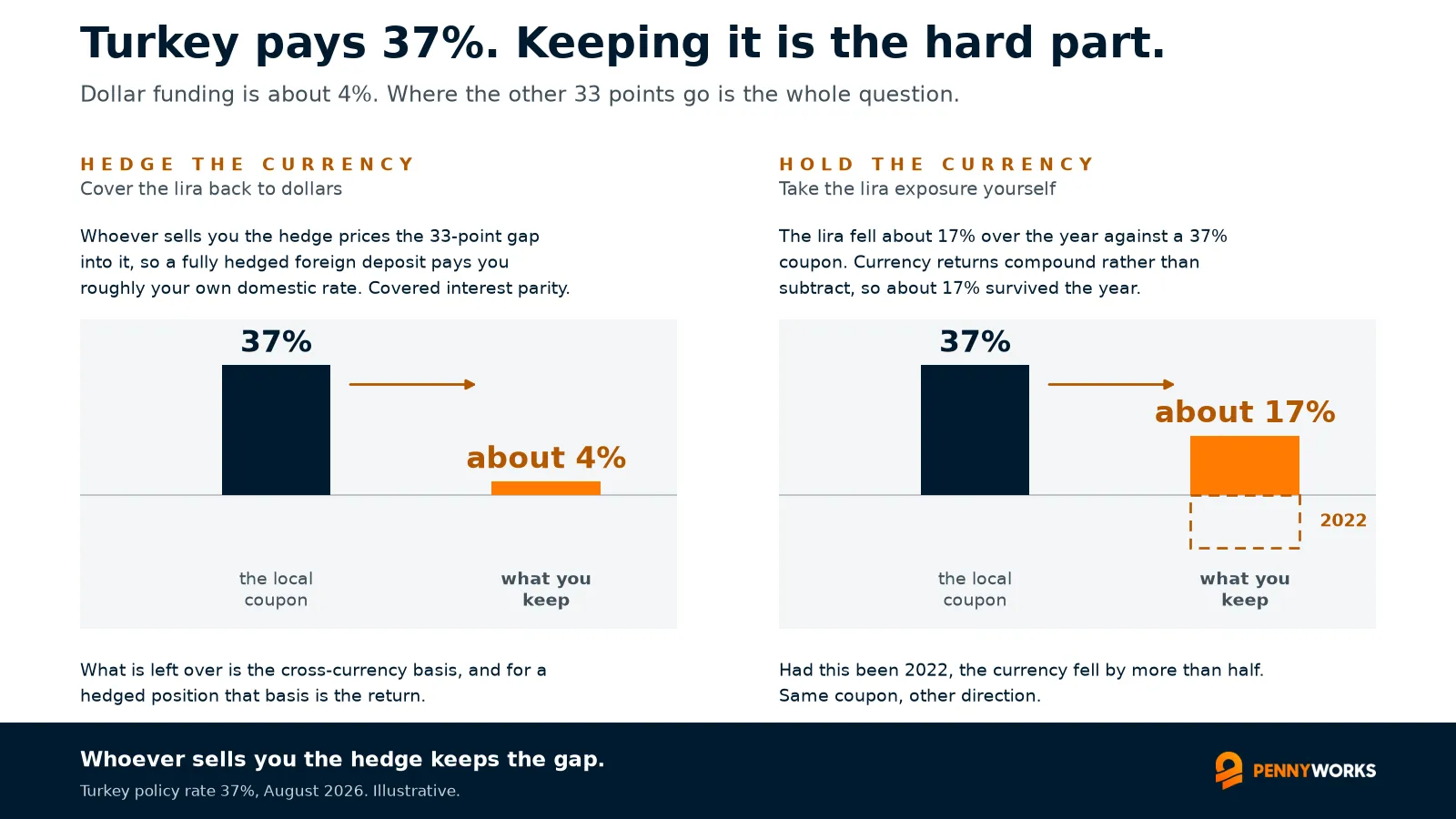
Section titled “Why the rate gap is not free money”Turkey’s policy rate is 37%. Dollar funding is around 4%. On the face of it, you earn a 33 point annual spread.
But FX rates move. One dollar was worth about 41 TRY around the same time last year and now it’s about 48 TRY, with consensus near 52 by year end. That is roughly 17% over the last twelve months, tracking the inflation differential closely.
So net of the currency move, you’d have earned about 17% unhedged. But it could also have gone badly had this been 2022, when the currency dropped by over 50%.
That leaves one choice, and it shapes everything below: hedge the currency, or hold it.
What a hedge takes out of the trade
Section titled “What a hedge takes out of the trade”There’s a cost to hedging, and net of the hedge the returns are smaller. The reason is mechanical.
Whoever sells you the hedge prices the rate differential into it. Sell a currency yielding 37% forward against one yielding 4%, and the forward trades at a discount of roughly that difference. Fully hedged, a foreign deposit returns approximately your own domestic rate. That relationship is covered interest parity.
Parity does not hold exactly. Balance-sheet limits, capital controls, regulatory ratios and local market plumbing all pry the two apart. That gap has a market price and is called the cross-currency basis.
For a hedged position, the basis is the return. Everything else in the 33 points goes to whoever sold the hedge.
Three ways to hold the position
Section titled “Three ways to hold the position”Same asset in all three. Different treatment of the currency.
1. Unhedged
Section titled “1. Unhedged”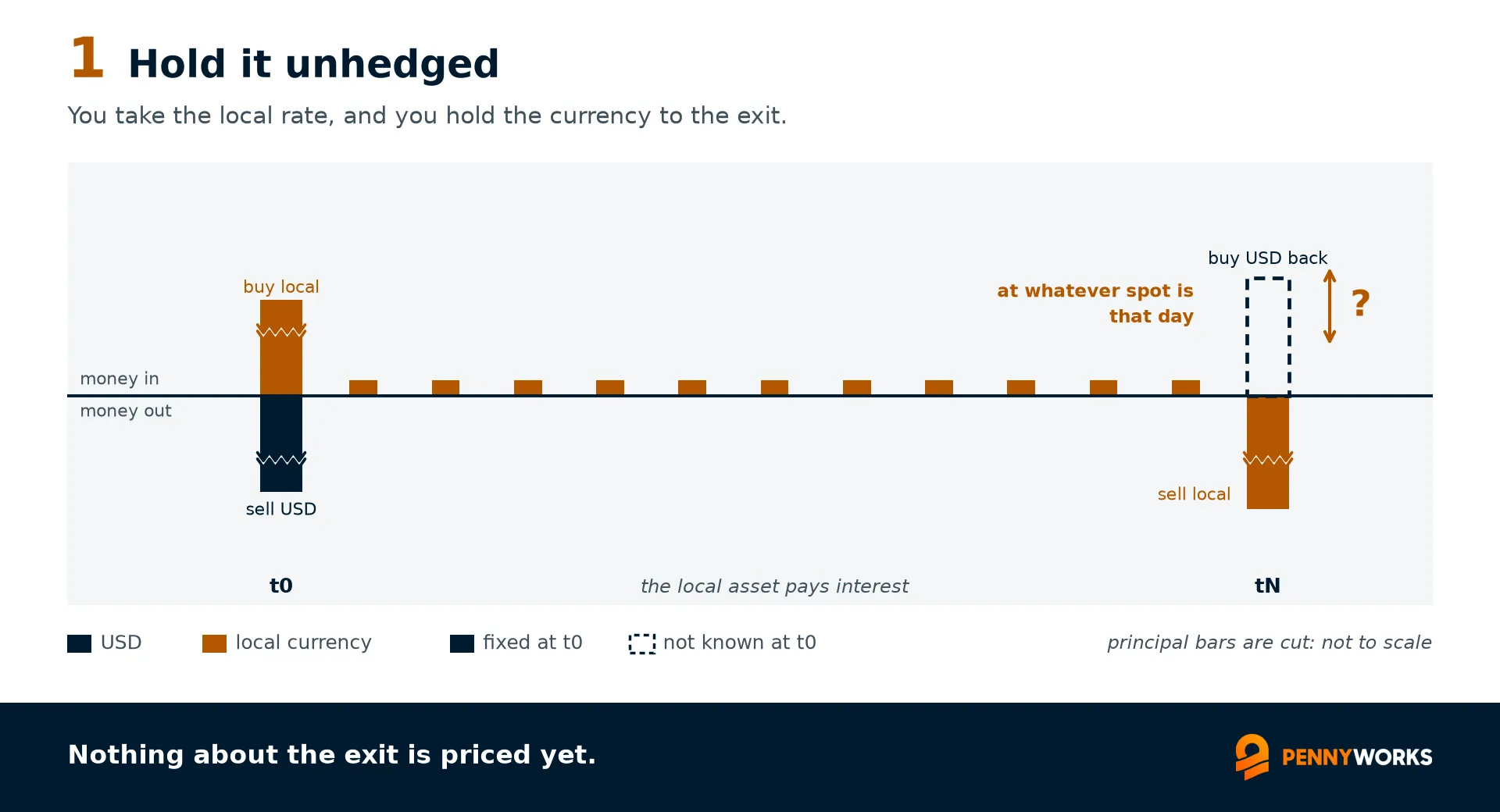
You receive the full local rate and you hold the currency. Your dollar return depends on where spot sits when you exit.
2. Hedged with rolling forwards
Section titled “2. Hedged with rolling forwards”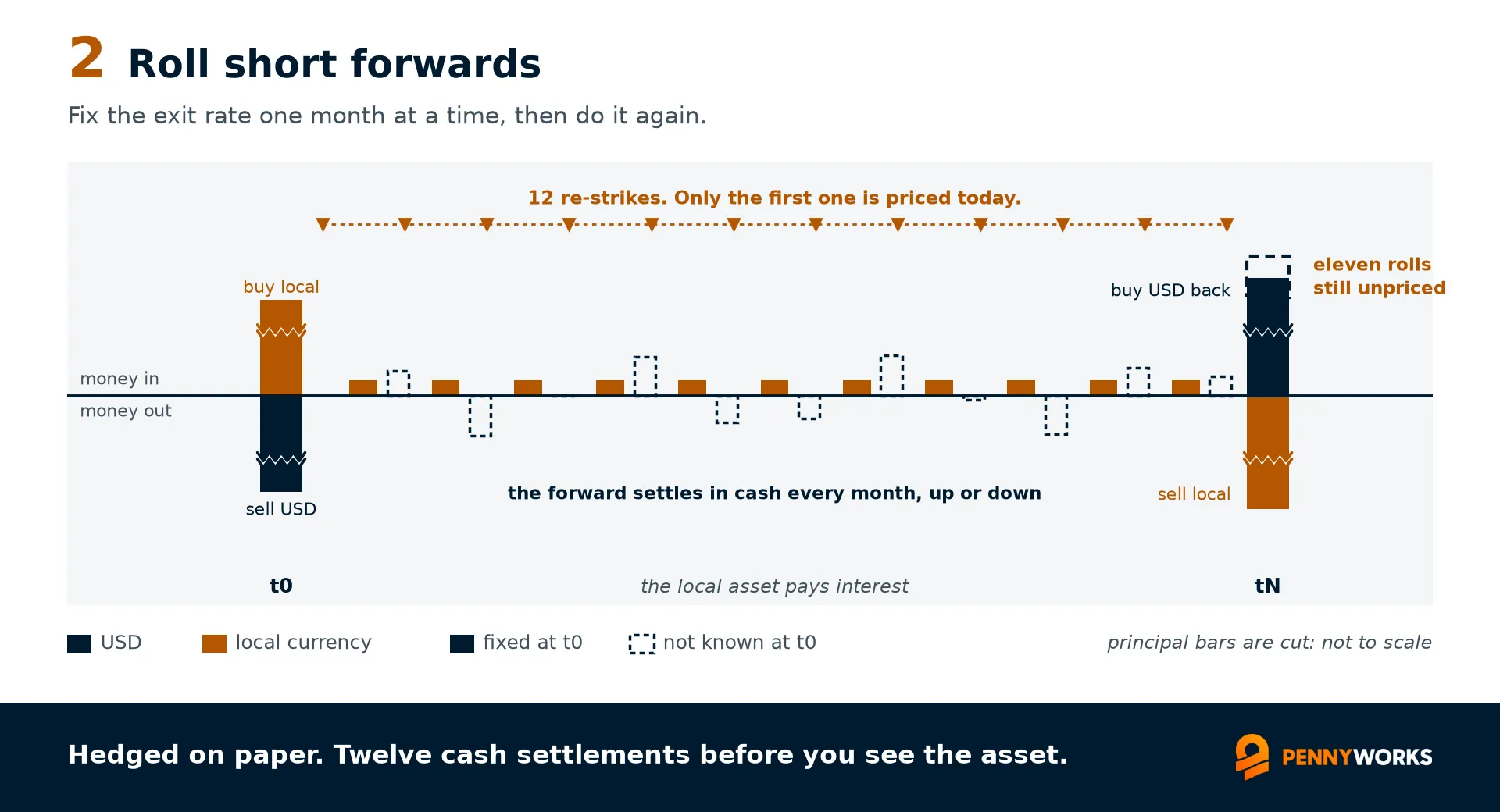
Cheapest and deepest market, shortest tenor. FX exposure is covered for a month at a time.
This is much easier to implement than the institutional version of the hedge (cross currency basis swap). Only the first roll is priced and hedged today. Eleven more get struck at whatever the forward points are on those mornings, so the all-in cost of holding this position for a year is not knowable on the day you put it on. You have removed the FX risk of the principal, while leaving open the risk of changes in the interest rate differentials between the two currencies.
Hedging also moves cash on its own account. Forwards settle at expiry. If the currency ran against your short leg that month, you owe the difference in cash on the day, while the offsetting gain on the local asset stays locked up until tN. Twelve settlements a year against one redemption at the end. You can be hedged in profit-and-loss terms and still be short of cash. How short depends on how far spot moved, which is entirely outside your control.
That is a liquidity requirement rather than a market view, and it is why a book like this must hold idle dollars to manage the margin risk.
Is rolling twelve times the same as hedging once?
Section titled “Is rolling twelve times the same as hedging once?”In G7 currencies, these two options are pretty close, or even if they aren’t, the gap is in low-single-digit percentages. Still large for the nature of the trade, but not catastrophic.
In emerging markets however, this gap can be huge. Forward pricing comes from the rate differential, not from anyone’s forecast. Buying a twelve-month forward locks the twelve-month differential today. Rolling locks twelve one-month differentials as they arrive. First-order, the difference is fixed against floating, exactly as in an interest rate swap: you either take the term rate now, or you take the realized average of the short rates and find out later.
Basis has a term structure. One-month and twelve-month deviations from parity are separate prices that move separately, and they diverge most in a funding squeeze. Rolling short is not the same instrument shortened. It is a different point on a curve that steepens under exactly the conditions that make you want the hedge.
However, you don’t get today’s expected average, every month you find out what the rates are, and they could be drastically different.
What the twelve prices look like
Section titled “What the twelve prices look like”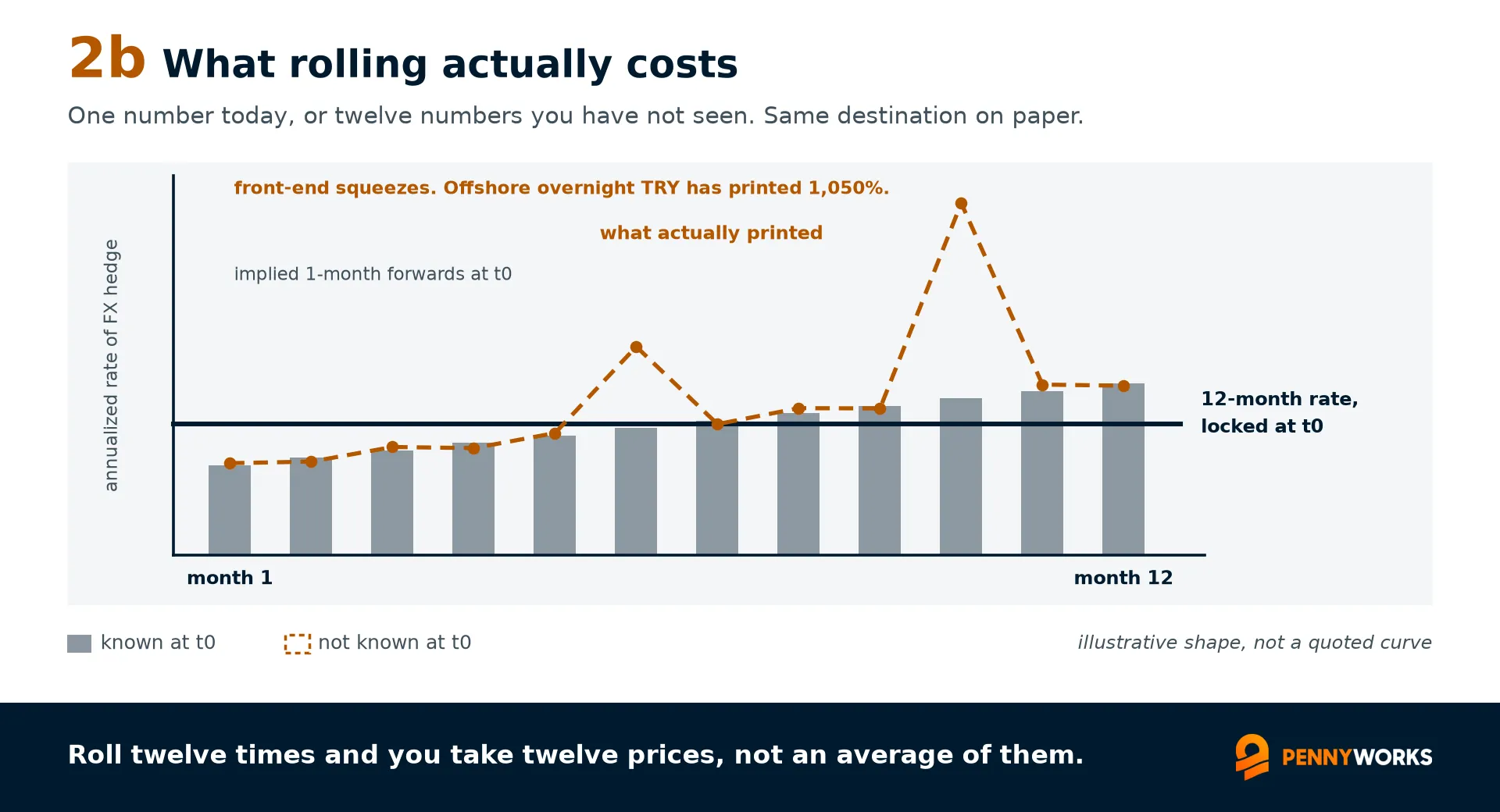
Arbitrage fixes the starting point. Those twelve implied one-month forwards compound to the twelve-month rate, because a curve that offered a cheaper path to the same place would be arb’ed away. Rolling is not a discount. It is a decision to take realized short rates in place of one locked term rate.
The realized rates can be drastically different. Front-end funding in a defended currency can gap hard, and Turkey is a good example: offshore overnight lira has previously printed 1,050% during a squeeze. Those episodes are rare, and if they land on the roll date when you have to re-hedge, you are out of luck.
So what’s the even safer alternative?
3. Cross-currency basis swap
Section titled “3. Cross-currency basis swap”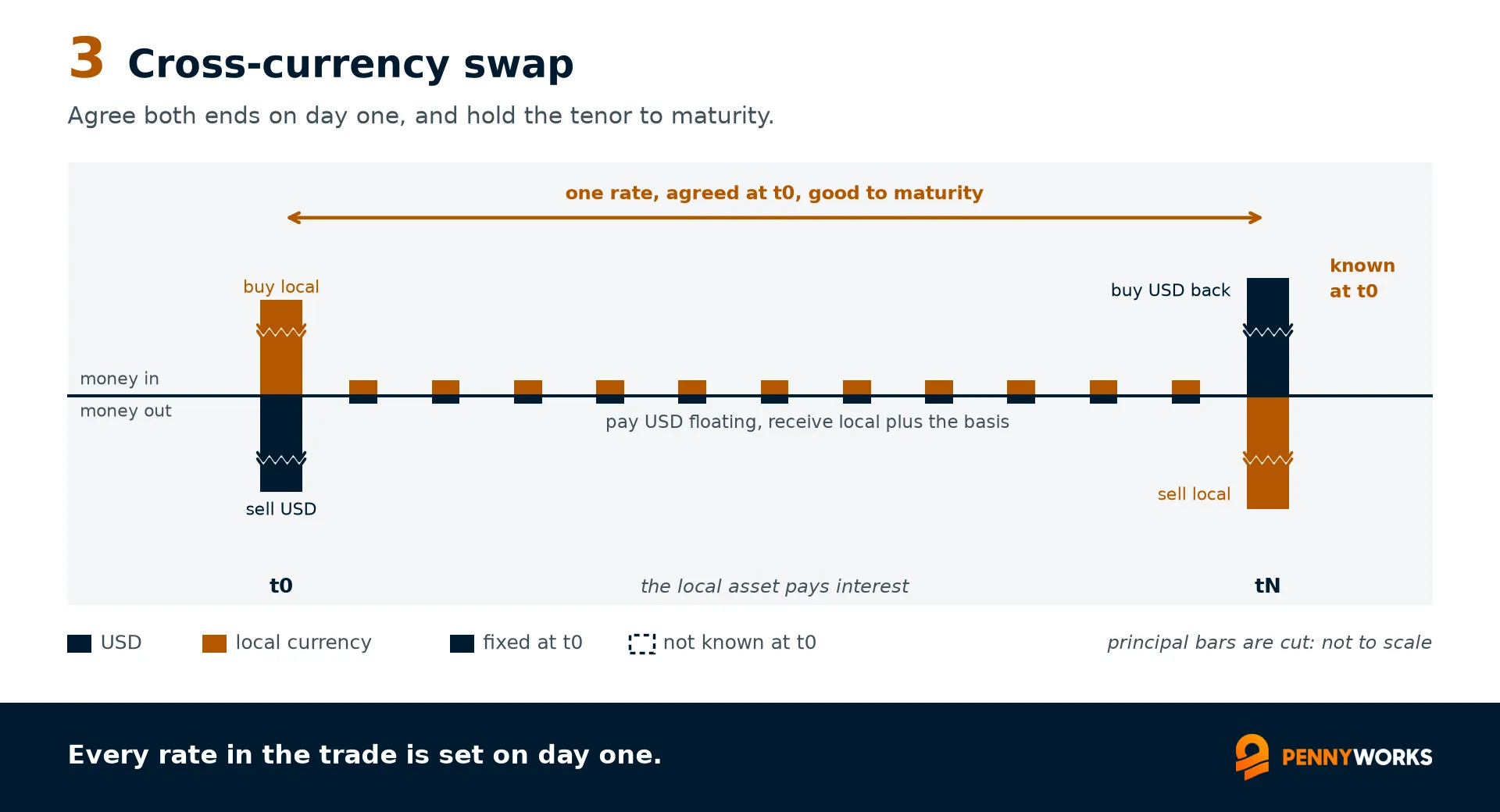
Principal is exchanged at the start and returned at maturity at the rate agreed on day one. That is the mechanism that removes the currency at exit, and it is why the tenor can be matched to the asset instead of rolled.
Set against the option above: every rate in this trade is fixed before the position exists. You can know the return on day one rather than assemble it from twelve prices you have not seen. That is the core difference between the two hedged structures, and it is not visible in the word “hedged”. Basis appears explicitly, as a spread on the local leg, rather than buried inside a forward price.
For a term asset this is the instrument that fits. Institutional research constructs hedged emerging-market returns from cross-currency swaps, lira included.
Watch the hollow bars disappear
Section titled “Watch the hollow bars disappear”Across the three charts, the fill carries the meaning: solid bars are quantities known on day one, hollow ones are the risks you take on by not hedging.
Chart one is hollow once, at the exit, and it is the largest bar on the page. Chart two is hollow twelve times over, in the settlements, plus a smaller hollow cap where eleven rolls remain unpriced. Chart three has no hollow bars at all.
Uncertainty drains out of the picture from left to right. Yield drains with it. Unhedged, you collect the local rate, roughly 42% in lira in the live example below, which is about 21% once converted. Hedged, around 11%. Removing the hollow bars is not free, and their disappearance is what you are paying for.
So a comparison of these products measures something other than trade quality. Higher numbers mean a different level of uncertainty, not better trades, and what matters is whether you are being paid enough to hold them.
What each one leaves you holding
Section titled “What each one leaves you holding”| Removes FX at exit | Reprices | You are left exposed to | |
|---|---|---|---|
| Unhedged | no | never | the currency |
| Rolling forwards | one month at a time | 12x a year | the basis at each roll |
| Cross-currency swap | yes, at the t0 rate | at maturity | the basis mark, margin, the counterparty |
What can still go wrong once hedged
Section titled “What can still go wrong once hedged”Tenor mismatch. Hedge a one-year asset with one-month forwards and you have roll risk. It is a hedged position eleven times renewed, and each renewal is priced at the basis prevailing that day. Basis widens when dollar funding tightens, which is the same condition under which a roll is hardest to place. That sequence ran in 2008 and again in March 2020.
The cross-currency basis still has a price. It moves daily. Hedged books carry a position in the cross-currency basis rate. For very large books, that risk can be substantial. That is the pure risk an FX RWA is theoretically supposed to carry. It is simply not generally available as a product outside the investment bank trading desks.
Margin. Forwards and swaps mark to market and call variation margin. You can be correct on a position and still be closed out, because the hedge leg wanted cash on a particular day.
Counterparty. FX Forwards are generally bilateral contracts. Hedging currency risk acquires counterparty risk. Exposure does not disappear. It gets converted from market risk to counterparty credit risk.
“Fully Hedged” is not a specification. Books hedged with term-matched cross-currency swaps and books hedged with a rolling stack of one-week forwards are both fully hedged, accurately, and the table above shows why they are not the same product. Delta-neutral describes direction. Tenor, instrument and basis are separate trades with their own risk factors.
What else the record shows
Section titled “What else the record shows”Carry returns are asymmetric. Long runs of small positive months, punctuated by large losses over short windows. Calm months are therefore weak evidence about risk, because calm months are what the strategy produces when it is working normally.
Crowded positions unwind together. In the yen carry unwind of August 2024, positions that had been stable for years moved further in days than their own history suggested was possible. Participants exit through the same route they entered.
Leverage changes duration, not probability. Unlevered spreads are thin, so the trade is usually levered. Leverage makes the prospect of funding flare-ups much more risky.
Market hours. FX markets close on Friday. Lending markets do not. Collateralized positions priced against a currency whose market is shut for 48 hours need proper mechanisms to synchronize fund flows.
Where each protocol puts the hard part
Section titled “Where each protocol puts the hard part”BRIX: sells you the exposure, and says so
Section titled “BRIX: sells you the exposure, and says so”BRIX does not hedge. It tokenizes the currency leg and hands you the decision.
iTRY is backed by a Turkish lira money market fund. Stake it for wiTRY, which accrues the
fund’s yield through supply expansion. On 29 July 2026 BRIX opened what it called the first onchain
FX carry market: post wiTRY as collateral on a Morpho market deployed by Featherlend on
MegaETH, and borrow USDM against it. Your carry is the spread between the wiTRY yield and the cost of the
dollar loan.
Read the structure. BRIX supplies the local leg and the venue to borrow against it. Currency risk, leverage and liquidation are all yours. There is no hedge to disclose, because the protocol does not run one.
That is also why BRIX had to solve the clock problem in the open. Its oracle provider built a hybrid adaptive TRY/USD feed using institutional FX desk data during market hours and switching to crypto exchange aggregation off-hours and at weekends, plus a NAV feed for the fund and a publishing timestamp feed so downstream protocols can see how stale a price is rather than acting on it blind.
That last feed is the interesting one. It does not improve the price. It makes staleness visible, so a downstream protocol can decide what to do about it.
BRIX raised $5.5M, led by the venture arms of Yapi Kredi and Is Asset Management, alongside Circle Ventures, ConsenSys and Borderless Capital.
Piku: hedged, and one strategy among several
Section titled “Piku: hedged, and one strategy among several”Piku issues USP, a stablecoin that appreciates rather than holding a dollar. Yield is not
distributed; 90% goes back into the backing, so each token becomes a growing claim.
Backing is split roughly in half. 50% sits in the BMMF Turkey FX Arbitrage Strategy, described as two to three delta-neutral trades a day in Turkish markets, capturing crypto and traditional spreads plus overnight rates while holding zero currency exposure through hedging. Another 50% is spread across Giza, Almanak, USD.AI, Ethena, Aave and Cap.
Two deliberate choices. The 50/50 split makes the Turkey trade a component rather than the product, so its capacity limits and its bad weeks arrive diluted. Minting requires KYC/KYB, with redemptions queued at 0.2% back into the backing, which is a choice to make exit orderly instead of instant.
On hedging, note what “two to three delta-neutral trades daily” implies about tenor. Daily turnover in local markets is a different risk profile from a term-matched swap, and the published description does not say which instruments carry the currency leg.
Allocations are set by PikuDAO vote, so the mix you underwrite today is changeable by governance rather than fixed in a contract.
Tori: names the mechanism, not the market
Section titled “Tori: names the mechanism, not the market”Tori issues trUSD, a synthetic dollar, and strUSD, an ERC-4626 wrapper whose exchange rate
climbs as the strategies earn. It filled a $50M pre-deposit cap in seven days and went live on
Ethereum in July 2026. Founded by Samed Düzçay; seed led by Delphi Ventures with ScaleX
Ventures and QInvest.
Documented strategies are money markets, futures arbitrage and calendar spreads, delta-neutral, executed through institutional desks with assets at qualified custodians in segregated accounts. Attestation by Accountable. Fees are 10% of performance, nothing on deposit, staking or unstaking.
Tori describes the money-market leg the way a desk would: fund in a low-rate currency, deploy into higher-rate local money markets, fully hedge the currency back to dollars, and keep the residual spread. That is the correct description of harvesting the basis, and it is the most precise public account of the mechanism among the three.
What is not published is the market, the instrument or the tenor. Tori’s documentation refers to “short-duration instruments in select global markets” without naming a currency, and the same holds in an independent research review from this month and in press coverage.
Here is how to read that. Disclosing at the strategy level rather than the position level is a normal choice for a managed product, and it is the convention across most of traditional asset management: a fund tells you the mandate and the controls, not the book. It also preserves capacity, since published positions in a capacity-constrained trade invite competition into it. What it means for an allocator is that diligence happens through the manager rather than off the page, which is a different process from that of a fully onchain vault.
“Short-duration” is the one available signal on tenor, and it points toward shorter hedges rather than term-matched ones.
What the numbers are measuring
Section titled “What the numbers are measuring”Live figures, 18 August 2026. Read the units before reading the numbers.
| TVL | Yield | Denominated in | |
|---|---|---|---|
| Tori | $64.1M | strUSD 11.09% | dollars |
| Piku | $33M | 14.4% on the $4M TVL FX arb vault | dollars |
| BRIX | about $9M | app shows 16.6% on a 60-day window | dollars |
Four questions to ask any of them
Section titled “Four questions to ask any of them”- Who holds the currency risk? BRIX gives it to you by design. Piku and Tori keep it and hedge it. Everything else follows from this answer.
- What instrument carries the hedge, and at what tenor? “Delta-neutral” and “fully hedged” are satisfied by a term-matched cross-currency swap and by a stack of one-week forwards alike, and those are different products wearing the same words. None of the three publishes this.
- What is the price when the market is shut? Chains run through the weekend and FX does not. Ask what the source is on a Saturday, and whether staleness is visible or silent.
- What is the redemption path under stress? Queues with a fee, AMMs with liquidity and liquidation engines behave very differently on the day everyone leaves at once.
Conclusion
Section titled “Conclusion”FX RWAs are expanding rapidly and many variations of the carry trade are already on offer. Whether it is multiple vaults (Piku), a diversified set of strategies in a single token (Tori) or composable yield with the currency leg left to you (BRIX), there’s something for everyone’s risk appetite. Crypto broadens access to innovative financial products, but does not remove the responsibility of understanding their internal mechanics. Before any deposits, it’s important to understand the key risk characteristics of each product and decide whether the expected returns match your risk profile.