

The 3 Reasons Why Algorithmic Stablecoins Fail
What Happened to Terra? Understanding the Collapse of UST and LUNA
Section titled “What Happened to Terra? Understanding the Collapse of UST and LUNA”Introduction
Section titled “Introduction”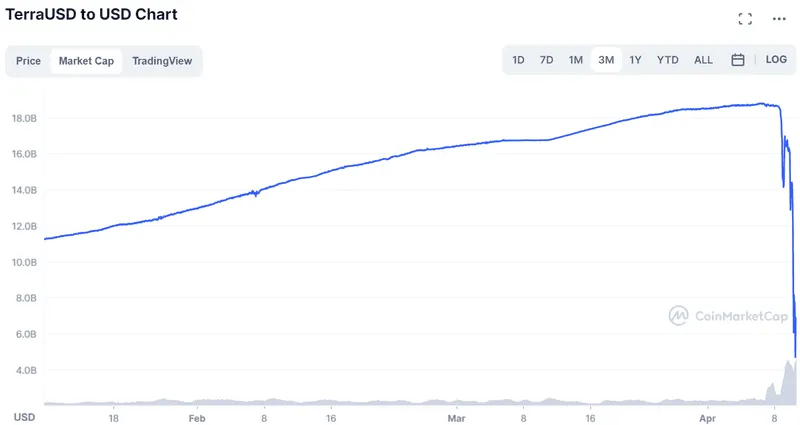
The Terra ecosystem became one of the biggest stories in crypto after the spectacular collapse of its native token, LUNA, and the loss of TerraUSD’s (UST) 1:1 peg to the U.S. dollar.
At its peak, UST grew to nearly $19 billion in market capitalization, making it one of the largest stablecoins in existence. When confidence disappeared, the unwind was rapid and devastating.
So what actually went wrong?
At a high level, algorithmic stablecoins often struggle because:
- The asset supporting the peg may not have sufficient intrinsic value.
- The stabilization mechanism can become self-reinforcing during periods of market stress.
- Aggressive incentive programs designed to accelerate adoption can increase systemic risk and contribute to a death spiral.
Let’s look at why.
A Primer on Algorithmic Stablecoins
Section titled “A Primer on Algorithmic Stablecoins”Terra was a full blockchain ecosystem with its own native token, LUNA, which functioned similarly to Ethereum’s ETH:
- It paid validator rewards.
- It was used to pay transaction fees.
- It secured the network.
Terra also introduced a stablecoin called UST, designed to maintain a value of 1 U.S. dollar.
One of UST’s innovations was usability. Users could transact directly in a dollar-denominated asset without needing to constantly convert between stablecoins and the native token.
But how was the peg maintained?
The Mint-and-Burn Mechanism
Section titled “The Mint-and-Burn Mechanism”UST was backed by $1 worth of LUNA, rather than by actual dollars held in reserve.
Whenever the price of UST drifted away from $1, arbitrageurs were expected to restore the peg.
If UST traded above $1:
- Buy $1 worth of LUNA.
- Burn the LUNA.
- Mint 1 UST.
- Sell the UST for more than $1.
- Profit.
If UST traded below $1:
- Buy discounted UST.
- Redeem it for $1 worth of newly minted LUNA.
- Sell the LUNA.
- Profit.
In normal market conditions, this arbitrage mechanism was intended to keep UST close to its target price.
The problem emerged when confidence disappeared.
Reason #1: The Supporting Asset Needed Intrinsic Value
Section titled “Reason #1: The Supporting Asset Needed Intrinsic Value”The stabilization mechanism depended on one critical assumption:
LUNA had to remain valuable.
When confidence in UST weakened, the protocol responded by creating additional LUNA to absorb redeemed UST.
If market participants no longer believed LUNA had meaningful value, newly minted LUNA became increasingly difficult to sell without driving its price lower.
That created a feedback loop:
- UST loses its peg.
- More LUNA is minted.
- LUNA’s price falls.
- The collateral supporting UST becomes weaker.
- Confidence declines further.
- Even more LUNA must be minted.
This positive feedback loop eventually became what is commonly called a death spiral.
Could LUNA Have Developed Independent Value?
Section titled “Could LUNA Have Developed Independent Value?”Supporters argued that LUNA’s value would eventually come from the Terra ecosystem itself.
If Terra attracted enough:
- developers,
- decentralized applications,
- users,
- and transaction activity,
then LUNA could derive value from securing the network rather than solely from supporting UST.
In theory, that would reduce the dependence between LUNA’s market value and UST’s stability.
Unfortunately, events unfolded before that separation could become meaningful.
Reason #2: The Stabilization Mechanism Became Pro-Cyclical
Section titled “Reason #2: The Stabilization Mechanism Became Pro-Cyclical”The redemption mechanism worked well when markets were calm.
During periods of stress, however, it behaved in the opposite way policymakers generally try to manage financial crises.
Instead of reducing pressure during panic, it amplified it.
Every redemption of UST required new LUNA to be created.
That additional supply immediately placed downward pressure on LUNA’s price, making future redemptions even more destabilizing.
In traditional finance, this is similar to implementing pro-cyclical policies—actions that reinforce economic downturns rather than dampen them.
Even if LUNA had substantial independent value, the stabilization mechanism itself increased the correlation between UST and LUNA precisely when diversification was needed most.
Reason #3: Growth Incentives Increased Systemic Risk
Section titled “Reason #3: Growth Incentives Increased Systemic Risk”UST adoption was heavily encouraged through generous incentives.
These programs successfully attracted enormous amounts of capital and rapidly expanded the circulating supply of UST.
The downside was that the larger UST became relative to the ecosystem supporting it, the greater the burden placed on LUNA whenever redemptions accelerated.
Had Terra:
- grown more organically,
- diversified the utility of LUNA,
- and limited the expansion of UST,
the system may have had greater resilience.
Instead, rapid adoption increased the scale of the eventual unwind.
The underlying stabilization mechanism remained fundamentally vulnerable, and larger adoption only magnified the consequences when confidence broke.
Conclusion
Section titled “Conclusion”Creating a decentralized stablecoin remains one of the industry’s most ambitious goals.
Terra demonstrated both the promise and the risks of algorithmic stabilization mechanisms.
Whether a purely algorithmic stablecoin can maintain long-term stability without introducing self-reinforcing failure modes remains an open question.
Fortunately, the digital asset ecosystem includes several alternative approaches to stablecoins:
- USDC, issued by Circle, is backed by traditional reserve assets.
- USDT has become one of the most widely used centralized stablecoins.
- DAI uses decentralized overcollateralization and has maintained one of the longest operating histories among decentralized stablecoins.
While Terra’s UST experiment ended in collapse, innovation in stablecoin design continues. Future systems will undoubtedly build on the lessons learned from one of crypto’s most significant failures.